Understanding the Shortcomings of Words
What is “defusion”? And why is it so important? According to John Blackledge, PhD, acceptance and commitment therapy (ACT) researcher…
Understanding the Shortcomings of Words Read More »

What is “defusion”? And why is it so important? According to John Blackledge, PhD, acceptance and commitment therapy (ACT) researcher…
Understanding the Shortcomings of Words Read More »

Editor’s note: This post is written by Steven C. Hayes, PhD, co-founder of Acceptance and Commitment Therapy and author of many
Is Self-Compassion More Important than Self-Esteem? Read More »

In acceptance and commitment therapy (ACT), it is understood that over-identification with literal language can lead to psychological inflexibility, which
Final Notes on The Use of Metaphor in Psychotherapy Read More »

Language is a tricky, powerful thing. It can play tricks on us and bring about suffering, but it can also
Using Language to Heal in Therapy Sessions Read More »

Editor’s note: The following was adapted from the edited volume, Mindfulness and Acceptance in Social Work, edited by Matthew S. Boone, LCSW.
Why ACT is so Well-Suited to Social Work Read More »

Editor’s Note: This is the second half of a two-part Q&A with the editors of The ACT Matrix: A new Approach
Q&A: Editors of The ACT Matrix, Part Two Read More »
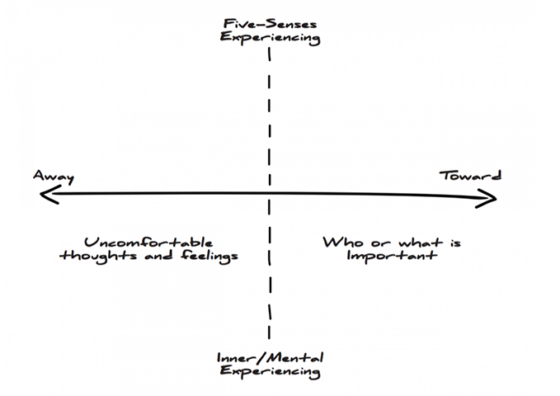
Editor’s Note: This is part one of a two-part Q&A with the editors of The ACT Matrix: A new Approach to
Q&A: Kevin Polk, PhD, and Benjamin Schoendorff, MA, MSc, editors of The ACT Matrix Read More »

When people enter therapy, they’re stuck, which is another way of saying inflexible. People can get stuck in all sorts
Sorting Stories Through the ACT Matrix, and Quick Verbal Aikido Read More »

Editor’s Note: This is the second part of a two-part Q&A with one of the authors of ACT and RFT in
Q&A: JoAnne Dahl, PhD, Part Two Read More »